


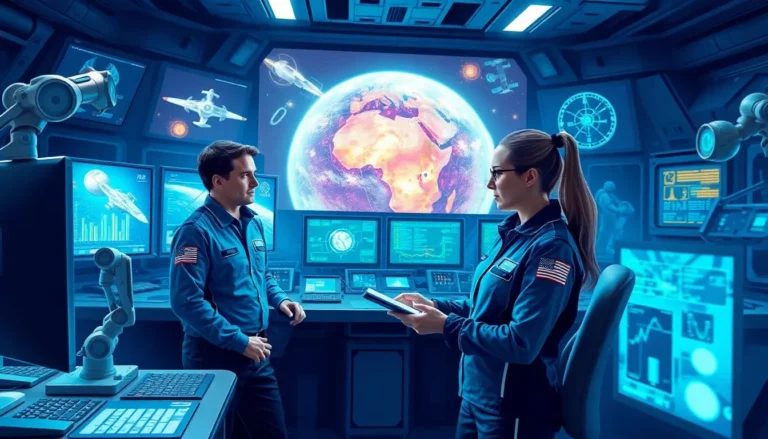

In a universe where the only thing cooler than a lightsaber is the technology propelling us into space, the race to explore the cosmos has never been more thrilling. From rockets that can land themselves like a pro at a party to satellites that can spot your neighbor’s new pool from orbit, technology in space is reshaping our understanding of the final frontier.
Imagine a world where astronauts sip coffee from zero-gravity mugs and drones deliver snacks to the International Space Station. It’s not just science fiction; it’s happening right now. As we push the boundaries of innovation, the possibilities are endless, and the stakes have never been higher. Buckle up as we dive into the fascinating world of space technology where every breakthrough could be the next giant leap for mankind—or at least a really cool gadget.
Overview of Technology in Space
Advancements in technology are reshaping endeavors in space exploration. Major breakthroughs in satellite design have led to enhanced Earth observation capabilities. Satellites gather vast amounts of data, providing insights into climate change, natural disasters, and urban growth. Relying on sophisticated sensors and cameras, these satellites enable real-time monitoring of Earth’s surface.
Innovative spacecraft are equipped with powerful propulsion systems. These systems facilitate travel beyond low Earth orbit, paving the way for missions to Mars and beyond. Rockets with self-landing capabilities decrease launch costs significantly while increasing reliability. NASA and SpaceX both exemplify this trend by successfully returning vehicles to land post-mission.
Robotics play a crucial role in space exploration. Robotic arms and rovers operate on planets like Mars, conducting research and gathering samples autonomously. These technologies reduce risk for human astronauts while expanding the reach of scientific inquiry.
Moreover, communication technology continues to advance. High-bandwidth connections allow for faster data transmission between Earth and space missions, enhancing collaboration among scientists globally. As a result, teams can analyze data and make decisions more swiftly.
Collectively, these advancements are not merely theoretical. Innovations like reusable rockets and autonomous drones are already altering how space missions are conducted. Each breakthrough contributes to a future where expanding human presence in space becomes increasingly feasible.
Advancements in Space Exploration
Exciting developments in space technology continue to enhance the field of exploration. Innovations in robotic and manned missions significantly reshape our understanding of the universe.
Robotic Missions
Robotic missions play a crucial role in gathering data from distant celestial bodies. Rovers such as Perseverance and Curiosity explore Mars, searching for signs of past life and collecting samples. These machines provide invaluable insights while minimizing risks to human astronauts. Satellites continuously monitor Earth’s climate, delivering real-time data on atmospheric changes. Advances in artificial intelligence allow for autonomous decision-making in remote operations, increasing mission efficiency. Robotic arms aboard the International Space Station assist astronauts in performing intricate tasks, showcasing the synergy between human and robotic capabilities.
Manned Spaceflight
Manned spaceflight technology has advanced significantly, enhancing human presence in space. Spacecraft like SpaceX’s Crew Dragon facilitate transport to the International Space Station, reducing travel time. Innovations in life support systems ensure astronauts thrive in harsh conditions, making extended missions possible. Plans for lunar bases and Mars habitation focus on sustainable living and resource utilization. Training programs emphasize safety and preparedness, equipping astronauts for various scenarios. Increased collaboration among nations fosters shared goals in manned exploration, uniting efforts to push boundaries further.
The Role of Satellites
Satellites play a critical role in modern space technology, supporting a range of applications that enhance daily life on Earth and in space.
Communication Satellites
Communication satellites facilitate the transmission of data across vast distances. They enable phone calls, internet access, and broadcasting services. Positioned in geostationary orbit, these satellites maintain a fixed position relative to Earth, ensuring stable connections. They also support emergency services by providing reliable communication during natural disasters. The advancements in satellite technology allow for higher bandwidth, enabling faster data transfer rates and improved connectivity, especially in remote areas.
Earth Observation Satellites
Earth observation satellites monitor environmental changes and provide vital data for climate research. These satellites collect imagery and data regarding urban development, agricultural practices, and natural disasters. Equipped with advanced sensors, they capture high-resolution images, contributing to disaster response and resource management. Insights derived from this data help scientists understand climate patterns and track deforestation, ultimately aiding global efforts against climate change. The continuous improvement in satellite technology increases the frequency and accuracy of Earth observations.
Emerging Technologies
Innovations continue to shape the landscape of space technology, introducing groundbreaking tools and methodologies that enhance exploration and sustainability.
Artificial Intelligence in Space
Artificial intelligence plays a pivotal role in optimizing space missions. Rovers like Curiosity and Perseverance utilize AI to navigate unfamiliar terrains autonomously. Equipped with machine learning algorithms, these systems analyze data in real-time, identifying scientific targets and making independent decisions. Enhancements in AI technology enable mission planners to optimize resources and adapt to unexpected challenges. Researchers leverage AI for analyzing vast datasets collected from Earth and celestial bodies, streamlining the process of drawing actionable insights.
3D Printing for Space Missions
3D printing revolutionizes manufacturing in space exploration. This technology allows for on-demand production of parts, reducing the need for extensive supply missions. Astronauts can create tools and equipment tailored to specific tasks, increasing efficiency during missions. NASA’s experiments on the International Space Station demonstrate the feasibility of printing components using materials available in space. Successful applications include creating spare parts for repairs and even food items, which may support long-duration missions. This flexibility in manufacturing promises to enhance future missions to Mars and beyond, minimizing logistical challenges.
Challenges and Future Directions
Technological advancements in space come with significant challenges. Launch costs remain high, limiting access to space for many organizations. Innovations in reusable rockets help reduce expenses but still require substantial investments.
Space debris poses another major hurdle, threatening satellites and manned missions. Tracking and managing debris needs enhanced monitoring systems to protect ongoing operations. Collaboration among nations and organizations is vital for developing effective solutions.
Communication delays in deep space missions hinder real-time decision-making. The distance to celestial bodies means signals can take minutes to travel, complicating mission dynamics. Research into advanced communication systems aims to mitigate these delays.
Radiation exposure presents serious risks for astronauts on long-duration missions. Protection against cosmic radiation requires innovative materials and engineering strategies. Ongoing research seeks to develop shielding technologies for future lunar and Martian habitats.
Sustainability is crucial for long-term human presence in space. Life support systems must efficiently recycle resources to reduce dependence on Earth. Research on closed-loop life support systems will play a key role in future habitations.
Future directions include expanding robotic capabilities for deeper exploration. Robotics can conduct scientific tasks without putting humans at risk, making them essential for missions to Mars and beyond. Ongoing development of autonomous systems continues to enhance robotic efficiency.
Collaboration between public and private sectors in space exploration is also evolving. Partnerships can accelerate innovation and reduce costs while expanding research capabilities. This growing synergy will likely redefine the future of space technology.
Advancements in propulsion technologies are another exciting frontier. Developing more efficient engines can significantly shorten travel times to distant destinations. Focus on advanced propulsion systems will lead to faster interplanetary exploration and discovery.
The advancements in space technology are paving the way for a new era of exploration and discovery. As innovations continue to emerge they not only enhance our understanding of the universe but also improve life on Earth. The integration of robotics artificial intelligence and advanced propulsion systems is setting the stage for ambitious missions to Mars and beyond.
While challenges like high costs and space debris remain significant the collaborative efforts of governments and private sectors are driving progress. The future holds exciting possibilities as humanity pushes the boundaries of space exploration. With each breakthrough the dream of a sustainable presence in space comes closer to reality.